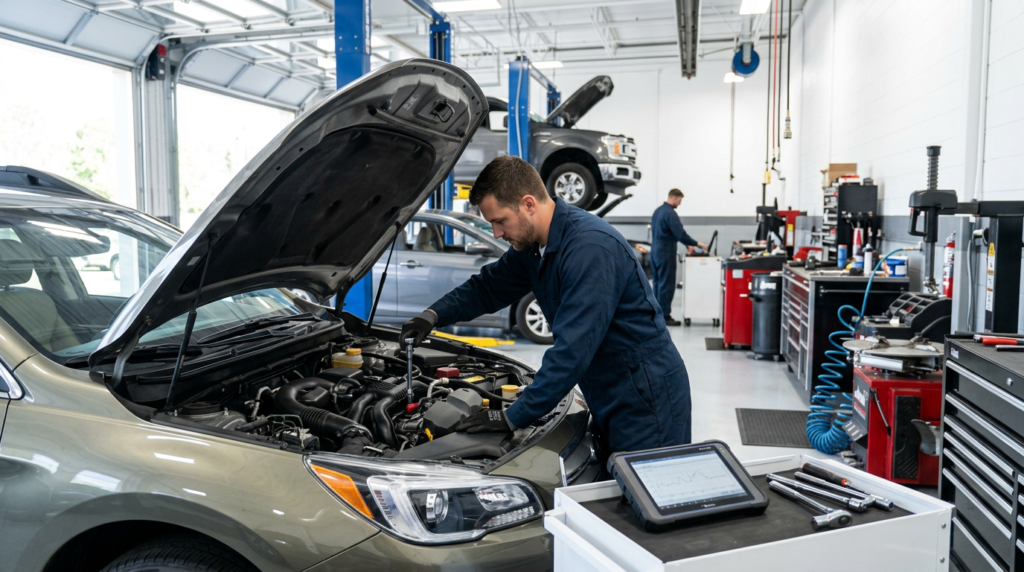
Quick answer: Reliable automotive repair in Cumming, GA starts with a shop that can clearly explain the diagnosis, show you what failed, and prioritize safety-critical items first. Look for technicians who use scan tools plus hands-on testing, provide a written estimate, and offer a clear warranty in writing. A good shop will also explain post-repair verification steps and set expectations for updates before work begins.
What “Reliable” Looks Like In A Local Repair Shop
Reliability is less about a fancy waiting room and more about process. A trustworthy shop will ask targeted questions (when the problem happens, what changed recently, any warning lights), then confirm the issue with testing instead of guessing. You should get a clear explanation in plain language, along with the parts and labor being recommended and why.
If you’re searching for automotive repair Cumming GA, pay attention to how the shop handles your estimate. A solid estimate separates “needs now” items (brakes, steering, severe leaks, overheating) from “plan soon” maintenance (fluids, belts, tires nearing wear bars). They should also tell you what they checked to rule out other causes—especially for problems that can be intermittent.
Good communication is a reliability signal. You shouldn’t have to chase updates, and you shouldn’t feel pressured into add-ons that don’t match your symptoms or mileage.
Red Flags And Green Flags During Diagnosis
Modern cars can throw codes that point to a system, not a specific failed part. A green flag is a shop that treats codes as clues and follows up with pinpoint tests—checking fuel trims, smoke-testing for vacuum leaks, verifying sensor signals, or doing a battery/charging system load test. Another green flag is showing you worn components (cracked belt, leaking strut, thin brake pads) and explaining the consequence of waiting.
Red flags include “we’ll just replace the most common part” without testing, vague language like “your car is fine now” without describing what was done, or recommending major work without explaining the failure mode. Be cautious if a shop can’t tell you whether a noise is likely rotating (tires/wheel bearings/axles) versus engine-speed related, or if they won’t discuss why a repair is the best first step.
Common Issues And Quick Triage For Metro Atlanta And North Georgia Driving
In the metro Atlanta/North Georgia area, typical patterns include heat and humidity stressing cooling systems and A/C, stop-and-go traffic accelerating brake wear, and highway commuting making tire balance and suspension wear more noticeable. These are common tendencies, not guarantees for any specific vehicle.
Use this quick triage to decide what’s urgent versus what can usually wait a few days:
Symptom → likely risk → what to do
Overheating or temp gauge climbing → engine damage if driven hot → Today: pull over, shut off, tow if it won’t cool/holds temp. This week: pressure test, thermostat/fan checks, leak inspection.
Brake grinding/squeal or pedal feels soft → reduced stopping power, rotor/caliper damage → Today: limit driving, avoid highways, schedule ASAP. This week: full brake inspection, measure pads/rotors, check fluid/leaks.
Vibration at 55–75 mph → tire/wheel/suspension issues, uneven tire wear → Today: check tire pressures, look for obvious bulges. This week: balance/rotation, inspect wheel bearings, suspension and alignment.
Flashing check-engine light → active misfire, possible catalytic converter damage → Today: reduce load, avoid hard acceleration, get it scanned/diagnosed ASAP; tow if rough. This week: confirm root cause with misfire counters, fuel/ignition tests.
Battery light on or slow crank → possible no-start, charging failure → Today: minimize electrical loads, avoid shutting off if unsafe to restart, test ASAP. This week: battery/alternator/starter testing, cable and ground inspection.
Burning smell or fluid puddle → fire risk or major component damage → Today: stop driving if smoke/heavy leak, tow. This week: identify fluid type, inspect leaks, verify safe levels.
What To Ask Any Shop Before You Approve Repairs
A quick checklist keeps the conversation clear and helps you compare shops fairly:
1) What diagnostic tests will you perform beyond reading codes (smoke test, fuel pressure, electrical load test, road test)?
2) Will I get a written estimate that separates parts, labor, shop supplies, and taxes?
3) What parts options do you offer (OEM, aftermarket, remanufactured), and what are the trade-offs?
4) What warranty do you provide, and what does it cover (parts, labor, exclusions) and for how long?
5) What post-repair verification will you do (road test, re-scan for pending codes, leak recheck, brake bedding)?
6) How will you communicate updates, and how often (text/call), especially if the plan changes?
7) If the first repair doesn’t solve it, what’s the next diagnostic step and how is that billed?
When you call around in Cumming, include Team Ryan Automotive in your list and ask these same questions about estimates, diagnostic steps, and warranty terms.